A highly successful materials simulation college in Trieste
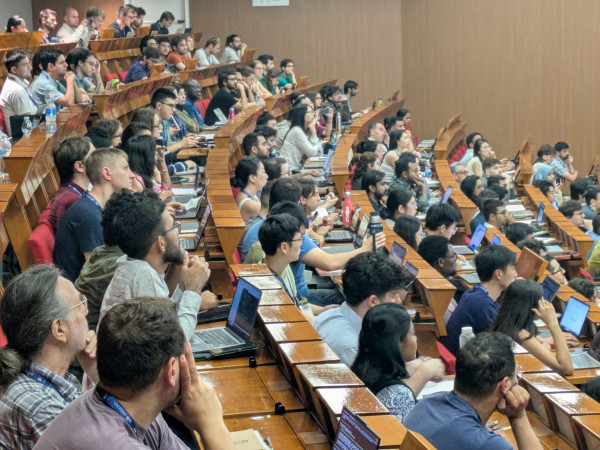
More than 200 participants from 57 countries and a team of over 40 lecturers and tutors animated the ICTP–MARVEL College on “Materials Simulations in the Age of AI”, that took place in Trieste (Italy) from 1 to 12 June. The college, organized as part of the final activities of MARVEL, included lectures and hands-on sessions covering fundamental concepts in computational materials science as well as cutting-edge developments. The topics ranged from elementardy density functional theory to GW methods, metadynamics, machine-learning interatomic potentials, Koopmans functionals, density-functional perturbation theory (DFPT), DFT+U, Wannier functions, and topological insulators.
The college was dedicated first and foremost to the MARVEL community, as well as to junior researchers all around the world. Thanks to the sponsors – the Abdus Salam International Centre for Theoretical Physics (ICTP), NCCR-MARVEL, and CINECA, the college had no registration fee and could offer fellowships covering accommodation, meals, and travel for 80 participants from developing countries, and partial fellowships for 40 more.
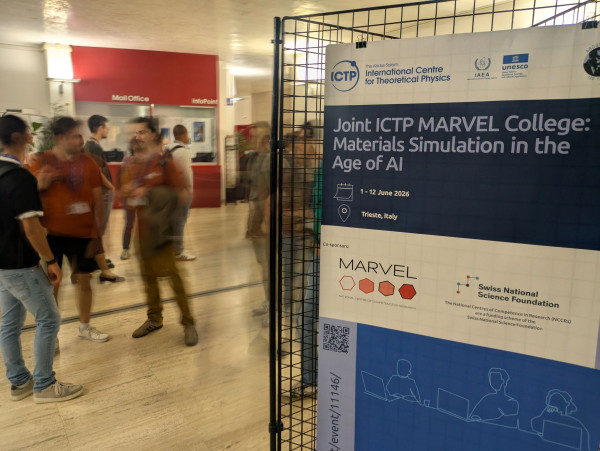
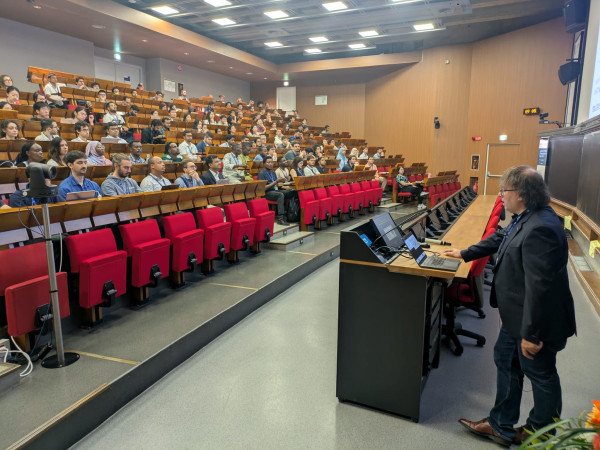
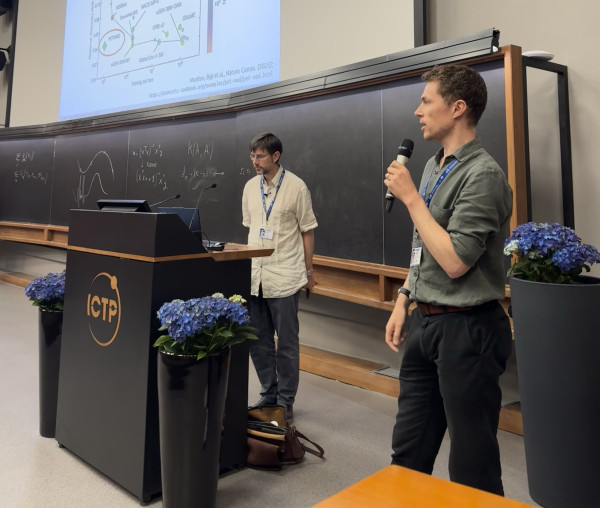
The college was organized by Sara Bonella (CECAM, EPFL, Switzerland), Michele Ceriotti (EPFL, Switzerland), Nicola Marzari (EPFL, Switzerland), Sandro Scandolo (ICTP, Italy), and the team also included Edward Linscott, Marnik Bercx, Iurii Timrov, Nicola Colonna.
“We had 200 students from over 50 countries and over 50 lecturers and tutors”, explains Edward Linscott, a postdoctoral researcher in Nicola Marzari’s group. “It was a rolling door of experts from the MARVEL community and beyond, and a lot of coordination was needed to turn all of that expertise into a coherent programme”.
Linscott explains that planning started several months in advance. But despite a great organization, and the ICPT team taking care of accommodation and logistics on the ground, there were unexpected issues
“For all the organizing that you can do there is always something that can throw a spanner in the works", says Linscott, "from unpredictably bad internet to the UNESCO Director General visiting ICTP for the first time in 10 years, that forced us to relocate lectures on that day. No beautiful spreadsheet can help you with that”.
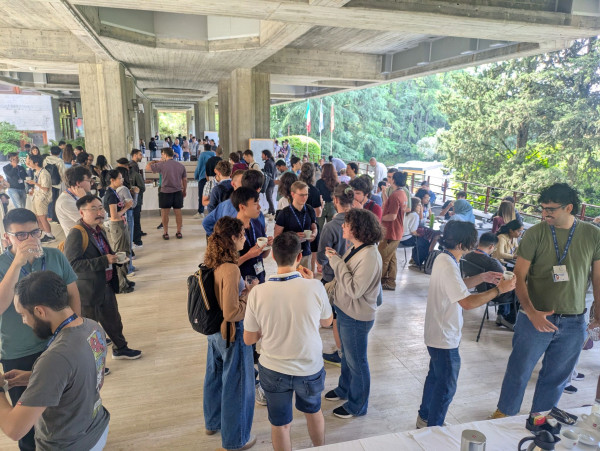
The chemistry of the students' group itself was key to the success of the school. “It was an incredibly diverse group, as it was evident on the final night when the DJ was taking suggestions for songs from so many different countries. It was diverse not only in terms of where they came from, but also in terms of exposure to different topics. I think this is where it helps to have such a broad programme, because some students may have been quite familiar with one day, but the next day they would hear something for the very first time”.
For Linscott, one of the most rewarding parts of the course was to watch MARVEL codes in action.
“In MARVEL we have this mission to create codes that can be disseminated and reused by everyone. And you can spend a lot of time preparing documentation and tutorial, but there is no replacement for spending time with a bunch of people locked in a room seeing them work with the code you’ve written work through the problems together. and ask questions about it was great”.