The study, led by Empa's and MARVEL's Vladyslav Turlo and described in a Scientific Highlight on our website, introduced a new, fast atomistic simulation technique that leverages spectroscopy data, machine learning, and molecular dynamics techniques to model how hydrogen interacts with thin alumina films manufactured through atomic layer deposition (ALD). Gramatte, previously a PhD student in Turlo's group, was the first author of the publication.
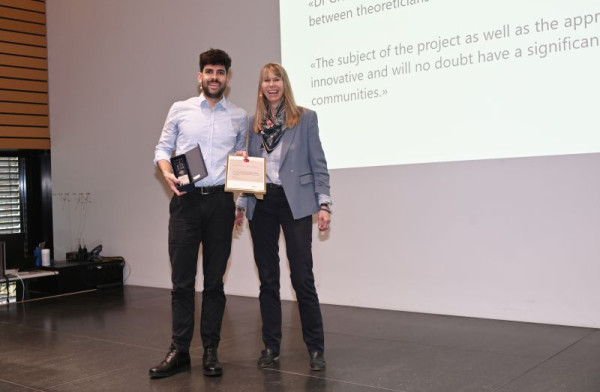
Empa Director Tanja Zimmermann, who presented the award to Gramatte in a ceremony on 9 December, wrote in a LinkedIn post that “Simon's research at Empa made a major contribution to advancing the understanding of amorphous alumina – a material that is widely used in high-tech applications yet has long remained poorly understood at the atomic level. By combining innovative experiments, high-performance simulations and machine learning, he and his collaborators succeeded for the first time in accurately modeling its disordered structure, including the critical role of hydrogen atoms. This work realizes the synergy between theory and experiment and will have a significant influence on the relevant communities.”