
Predicting the color of metals: a collaboration between MARVEL and the jewellery industry
by Nicola Nosengo, NCCR MARVEL
The icy gray of silver. The warm brown of copper. The mesmerizing yellow of gold. The colors of metals have fascinated humanity since the ancient times. They remain fascinating to this day to engineers who develop cutting-edge technologies, because the optical properties of metals can be exploited in applications like microscopy, optoelectronics, optical data storage. And of course, the colors of precious metals and of their alloys allow the jewellery industry to create new designs and fashions.
Being able to predict what color and what optical properties a new metal alloy will have, rather than just proceed by trial and error, would be a boon for product innovation. In 2015, the idea led to a unique collaboration between computational material scientists and a jewellery company.
It all began when Varinor – a refiner of precious metals based in Delémont, Switzerland - first got in touch with Gian Marco Rignanese, then a professor at Louvain University in Belgium, with the idea to test whether materials simulation could help find precious metal alloys with new colors (expand the color palette of precious metal alloys). Rignanese discussed the idea with NCCR MARVEL Director Nicola Marzari, and a PhD position funded by the company was made available at EPFL. Gianluca Prandini, who had just completed his Master’s degree at the University of Trieste, was offered the position, with Marzari as supervisor and Rignanese as co-supervisor. Prandini set out to develop a computational workflow to prove that the reflectivity and color of metallic crystals could be estimated realistically by first-principles techniques.
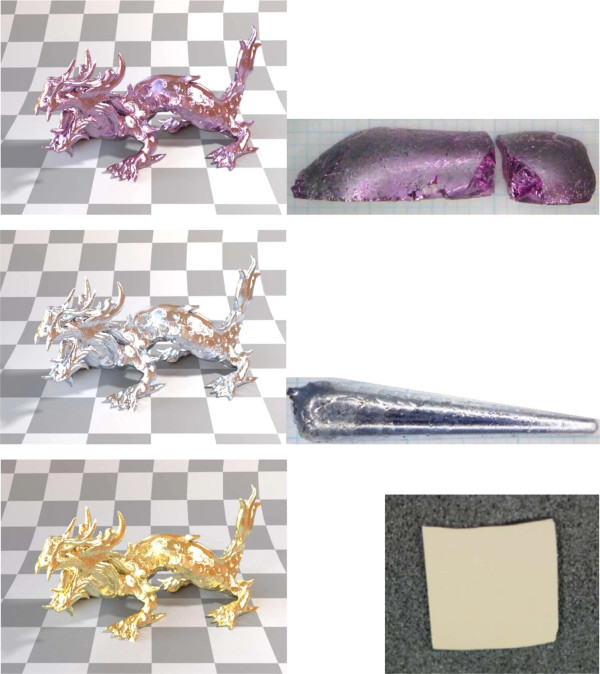
Comparison between the simulated rendering of a metallic surface (left panel) and real samples (right panel) of the intermetallic compounds AuAl2 (top), AuGa2 (centre) and PtAl2 (bottom). Adapted from Prandini, G., Rignanese, GM. & Marzari, N. Photorealistic modelling of metals from first principles. npj Comput Mater 5, 129 (2019). https://doi.org/10.1038/s41524-019-0266-0.
The company was mostly interested in investigating specific gold alloys, but the researchers chose to start from the simpler cases and build on them. “I started with basic metals like pure golds, silver, copper and elemental metals, because the computation was simpler and it was easier to compare with experiments,” says Prandini, who is now a physics high-school teacher in Italy.
The workflow had four main computational steps. First, starting from the metal’s crystal structure, the electronic structure was calculated with density-functional theory (DFT) with the (PBE) exchange-correlation functional. The second step was a calculation of the dielectric function that describes the material’s reaction to an electrical field, done with the independent particle approximation (IPA) method that neglects particle interactions. This step was done by a dedicated code, called SIMPLE, developed by Prandini and Marzari in collaboration with Paolo Umari from the University of Padua.
By knowing the dielectric function, it is possible to derive all the optical constants measurable by optical experiments, such as absorption coefficient and reflectivity (how incoming light is returns from the surface of the material into the medium). The most important property here is reflectivity: once you have a way to compute the metal’s reflectivity for any wavelength, you can calculate its perceived color as a combination of three or more basic color coordinates, using the standard color coding by the Commission Internationale de l’Eclairage (CIE): it’s the well-known RGB code that expresses any color as a different combination of red, green and blue.
The last step was a photorealistic rendering of the material using a software with Mitsuba, developed by Wenzel Jacob at EPFL. “The RGB code does not really tell you how a metal with that color would look like” says Prandini. “With the rendering software, you only need to input the type of material and its refractive index, and the type of light you want to simulate in the render. We typically instructed the software to simulate a not-too polished metal under natural light”.
The method could well reproduce the optical properties of most elemental metals, with a few exceptions. As it turns out, the exceptions were the noble metals like gold that are the most important for jewellery. This is a known problem of DFT, that is only approximate in describing electronic bands. Gold, for example, is computed as orange instead of yellow. Correcting these effects would have required computationally expensive methods, but the team decided not to use them, because the problem did not significantly affect the simulation of colors in binary alloys, which was the main goal of the project.
When it came to alloys, some were more difficult to simulate than others.
“Intermetallic compounds are easy: the cell can be larger and include 3 or 4 atoms, but the structure is well ordered and DFT works well”, explains Prandini. “But intermetallic compounds tend to be very fragile and are not often used in jewellery”. A good example, says Prandini, is AuAl2, that has a beautiful purple color that simulations reproduce to perfection (see figure). But it is very fragile and cannot be used for a structure like a ring.
Most gold compounds used in jewellery are solid solutions that have better mechanical properties. But those are harder to simulate because their atoms are randomly arranged in the crystal structure. The approach used here was to simulate supercells that somehow approximate the disorder of solid solution. “Simulations require periodic cells, but you can create them in a way that approximates randomness” says Prandini. That allowed the team to simulate some of gold-based alloys that are most interesting for jewellery. “We were asking questions like: what happens if we add palladium to gold? Or copper?” says Prandini. Also, the data produced was later used to train machine-learning models, making the loop from prediction to realization even faster.
The work resulted in multiple publications: an article in npj Computational Materials described the workflow and the simulation results, while another one in Computer Physics Communication described the SIMPLE code. Both the code and the workflow remain available via AiiDA and GitHub and are open-source.
References
Prandini, G., Rignanese, GM. & Marzari, N. Photorealistic modelling of metals from first principles. npj Comput Mater 5, 129 (2019). https://doi.org/10.1038/s41524-019-0266-0.
Prandini G., Galante M., Marzari N., Umari P. SIMPLE code: Optical properties with optimal basis functions, Computer Physics Communications, 240 (2019) https://doi.org/10.1016/j.cpc.2019.02.016.