From quantum mechanics to AI-driven materials discovery: MARVEL celebrates 12 years of reshaping computational science
What if the materials needed for cleaner energy, faster electronics, quantum technologies, better batteries or lighter aircraft could be discovered first on a computer — before they are ever made in a laboratory?
When first conceived in 2011, that was the bold vision behind the National Centre of Competence in Research MARVEL, on computational design and discovery of novel materials. On 9 July, scientists spanning materials science, physics and chemistry from Switzerland and abroad will gather at EPFL in Lausanne to celebrate the achievements, community and legacy of an initiative that helped turn that vision into a new way of doing science.
Launched in 2014, MARVEL set out to transform the design and discovery of novel materials by combining quantum-mechanical simulations, rapidly growing computational power and what was then still an emerging force in the field: machine learning. Its ambition was not only to make materials research faster, but to make it more predictive, systematic, reproducible and collaborative.
Today, that ambition looks strikingly prescient.
“This vision seems as fresh and compelling now as it was in 2011,” says MARVEL director and EPFL professor Nicola Marzari. “Some of the giant internet companies — from Google DeepMind to Microsoft to Meta — have started in the past 2–3 years major efforts in materials design and discovery, and this is mirrored by an influx of startups in the field – just four of them raising more than 800 million dollars in early-stage funding. And agentic AI - already present in the initial proposal — has now become a reality.”
For much of its history, materials science has advanced through painstaking trial and error: synthesize, test, fail, improve, repeat. MARVEL helped push the field toward a different paradigm. By bringing together physics, chemistry, computer science, high-performance computing, machine learning and experiments, its researchers developed ways to identify promising materials earlier, understand why they work, and share the methods and data needed for others to reproduce and build on those results.
Over 12 years, this approach produced key scientific advances across a wide range of materials. MARVEL researchers predicted and helped confirm new quantum materials, including systems with unusual electronic states relevant to future electronics and quantum technologies. These were not only isolated discoveries: they turned long-standing scientific puzzles into clearer principles for designing materials with targeted properties.
MARVEL also strengthened the computational foundations on which modern materials science depends. Its teams developed advanced electronic-structure methods and incorporated many of these capabilities into open-source codes used by researchers worldwide. At the same time, MARVEL helped pioneer machine-learning methods for molecules and materials, creating AI models that are now among the state-of-the-art in the field.
During MARVEL’s lifetime, machine learning moved from a promising add-on to a central research tool. It became a way not only to accelerate atomistic simulations, but also to predict increasingly complex properties: spectra, chemical environments, electronic structure, diffusion and more. In doing so, MARVEL helped prepare the ground for the current global surge of interest in AI-driven materials discovery.
The initiative also tackled problems with direct societal relevance. Its researchers studied materials for solar cells, water splitting, batteries and solid-state ion conductors; nanoporous materials for catalysis and separation; molecular crystals relevant to chemistry and pharma; two-dimensional materials only a few atoms thick; and advanced alloys for high-performance manufacturing. In later years, MARVEL’s portfolio expanded further toward aerospace alloys, spectroscopy, automated experiments and hybrid quantum-classical algorithms.
But MARVEL’s legacy is not only what it discovered. It is also how it changed the way discoveries are made.
From the beginning, MARVEL placed open science and open-source software at the centre of its mission. It promoted verification efforts that make the codes used by the global materials science community more reliable and their results more reproducible. By the end of the programme, MARVEL had shown that simulations, data handling and experiments can be connected in a single reproducible chain — and, in some cases, that computational workflows can help steer automated experimental platforms.
One of its most durable contributions is a Swiss digital ecosystem for materials science. What began as a network centred at EPFL and involving ETH Zurich, PSI, Empa, CSCS and partner universities evolved into a national platform for computational materials research. Its most visible pillars include the AiiDA and AiiDAlab computational infrastructures, the Materials Cloud dissemination platform, and the Lhumos educational portal.
Together, these tools make complex simulations easier to run, reproduce, share and teach. They allow researchers to track how a result was produced, compare outputs from different simulation engines, publish reusable datasets, and turn expert computational workflows into accessible tools for a broader community.
MARVEL also built lasting bridges beyond academia. Over the years, the NCCR developed ties with a large industrial community spanning energy, electronics, metals, chemistry, catalysis and pharma. It engaged with dozens of companies and signed multiple collaborations. A key achievement was the move from software built primarily for specialists toward practical tools that can be adopted in industrial settings.
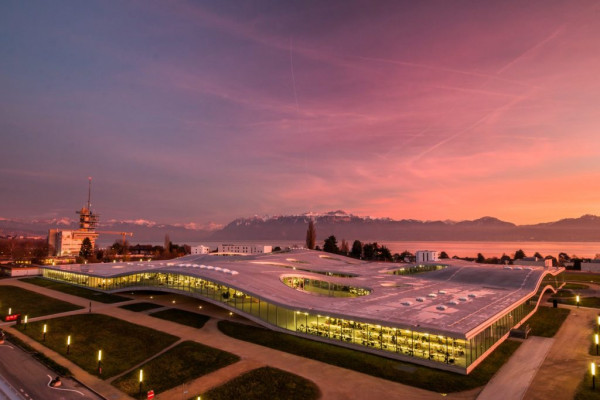
The closing event celebrating 12 years of materials discovery (MARVEL Fest: Party-ing away), will take place on 9 July at the Rolex Forum on the EPFL campus in Lausanne. The full-day event will bring together the people and partners who shaped MARVEL over the past 12 years. Sessions will focus on quantum materials, the design of new materials, machine learning and the expanding global community of computational materials science.
Speakers will include key MARVEL members, academics from leading research centres in Europe, North America and China, and industry representatives from Microsoft, BASF, Stellantis and others.
As MARVEL draws to a close, its central idea has become more relevant than ever: the materials of the future will increasingly be imagined, tested, shared and improved in digital form before they reach the laboratory. MARVEL helped make that future tangible — and helped place Switzerland at the heart of it.
The full programme is available here.