Unlocking the Magnetic Landscape of 2D Materials
Scientists have taken a major step toward unlocking the potential of ultra-thin magnetic materials, mapping their behavior in unprecedented detail and revealing new candidates for future electronics. In a study just published in ACS Nano, researchers led by Nicola Marzari at EPFL and Marco Gibertini at the University of Modena and Reggio EMilia systematically analyzed hundreds of atomically thin materials to understand how magnetism emerges and stabilizes at the nanoscale.
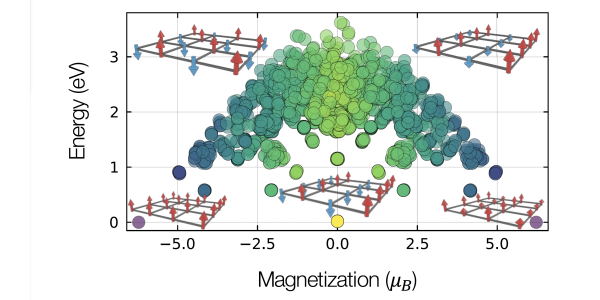
Two-dimensional materials—crystals just a few atoms thick—have fascinated scientists for years because they can exhibit unusual properties not found in bulk matter. Yet predicting their magnetic behavior has remained a stubborn challenge. They often exhibit complex energy landscapes with multiple local minima, the authors explain, meaning a single material can settle into many competing magnetic states. Identifying the true, stable configuration among these possibilities has been a long-standing obstacle.
To tackle this, the team developed an automated computational approach designed to explore this complexity more thoroughly than conventional methods. Starting from more than 3,000 candidate materials, they progressively narrowed the field, ultimately identifying 194 magnetic monolayers. These include a wide range of behaviors: 109 ferromagnets, in which magnetic moments align in the same direction; 83 antiferromagnets, where neighboring spins point in opposite directions; and even two examples of the recently discovered class known as altermagnets.
Adapted fromhttps://doi.org/10.1021/acsnano.5c16067
What makes the study particularly significant is its ability to reliably determine the true magnetic ground state of each material. Rather than relying solely on initial assumptions about spin alignment, the researchers systematically explored different electronic configurations, allowing them to “rapidly identify” stable and metastable states and pinpoint the lowest-energy solution. This deeper exploration provides a much clearer picture of how magnetism behaves in low-dimensional systems.
Among the most exciting results is the discovery of 12 new half-metals—materials that conduct electrons of one spin type while blocking the other. Such behavior is highly sought after in spintronics, an emerging technology that aims to use electron spin, rather than charge, to process and store information more efficiently. These materials could form the basis of faster, lower-power electronic devices.
The researchers also took steps toward understanding how these materials might perform in real-world conditions. By analyzing the energy differences between competing magnetic states, they identified which systems are likely to maintain magnetic order more robustly—an important factor for practical applications, where stability at higher temperatures is crucial.
Beyond specific discoveries, the study challenges conventional assumptions about magnetism itself. While transition metals are typically seen as the main drivers of magnetic behavior, the team found that elements like oxygen and nitrogen can also carry significant magnetic moments in certain two-dimensional structures. This opens the door to new, unconventional strategies for designing magnetic materials.
Taken together, the work offers one of the most comprehensive maps yet of magnetism in two-dimensional systems. By combining large-scale computational screening with sophisticated algorithms, the team has created a powerful framework for discovering materials that could underpin the next generation of spintronic devices, quantum technologies, and nanoscale electronics.
The research was supported by the Swiss National Science Foundation, including through the MARVEL National Centre of Competence in Research, and by the Italian Ministry of University and Research (Ministero Italiano dell’Università e della Ricerca) through the ECOSISTER and PRIN2022 SECSY projects.
Reference
Fatemeh Haddadi, Davide Campi, Flaviano Jose dos Santos, Nicolas Mounet, Louis Ponet, Nicola Marzari, Marco Gibertini, Exploring the Magnetic Landscape of Easily Exfoliable Two-Dimensional Materials, ACS Nano (2026). https://doi.org/10.1021/acsnano.5c16067