MARVEL Junior Seminar — April 2026
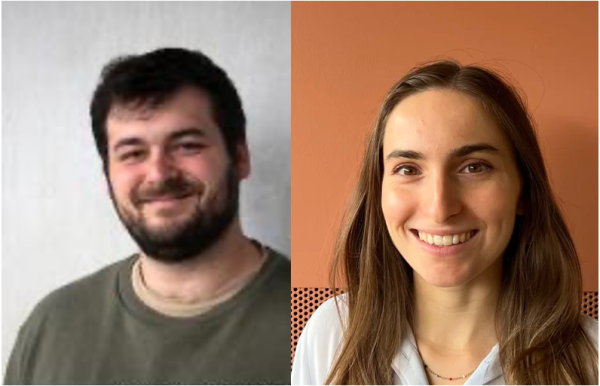
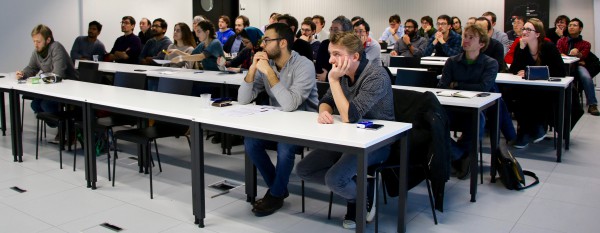
Each seminar consists of two presentations of 25 minutes each, allowing to present on a scientific question in depth, followed by time for discussion. The discussion is facilitated and timed by the chair.
Pizzas will be served after the seminars in order to facilitate discussions based on the talks just presented.
Onsite participation
12:15 — Seminars take place in EPFL room Coviz2 (MED 2 1124)
~13:15 — Pizzas will be served in the MED building atrium, second floor
Online participation
Starting at 12:15:
https://epfl.zoom.us/j/64619111138
Password: 167491
Abstracts
Talk 1 — Advances in Supercapacitor Modeling with Flexible, Disordered Electrodes
Zacharie Waysenson
Laboratoire de Physique de l’École Normale Supérieure, Sorbonne Université
Molecular simulations have become indispensable for characterizing the charging mechanisms of electrical double-layer capacitors. However, a significant gap remains between theoretical models and experimental reality, partly due to the approximation of rigid electrode frameworks and simplified pore geometries. In this work, we overcome these limitations by integrating constant-potential molecular dynamics with advanced machine-learning potentials to investigate the distinct roles of electrode flexibility [1] and structural disorder [2] on supercapacitor performance.
First, by employing a machine-learning potential for carbon to permit atomic relaxation, we compare rigid versus flexible nanoporous sp2/sp3 electrodes in ionic liquid electrolytes. We demonstrate that electrode flexibility significantly enhances in-pore ionic diffusivity, shortening the characteristic charging time by a factor of 3 compared to rigid analogues. This kinetic boost is driven by the electrode’s "breathing modes," which mitigate pore overcrowding and accelerate co-ion expulsion without compromising specific capacitance.
Second, we extend this approach to realistic, large-scale systems. Using controlled quench dynamics, we generated disordered nanoporous graphitic structures to systematically study the effect of pore topology. By applying constant potential MD to these realistic architectures, we successfully retrieve the anomalous increase in carbon capacitance at pore sizes below 1 nanometer [3]. Our findings provide a view of how mechanical flexibility regulates charging kinetics while pore size distribution dictates capacitance, offering new guidelines for the design of optimized carbon electrodes.
[1] Zacharie Waysenson, Arthur France-Lanord, Alessandra Serva, Patrice Simon, Mathieu Salanne, and A. Marco Saitta
ACS Nano 2025 19 (32), 29462-29469 DOI: 10.1021/acsnano.5c07490
[2] Zacharie Waysenson, Arthur France-Lanord, Alessandra Serva, Patrice Simon, Mathieu Salanne, and A. Marco Saitta
In preparation
[3] J. Chmiola, G. Yushin, Y. Gogotsi, C. Portet, P. Simon, and P. L. Taberna
Science 313,1760-1763(2006).DOI:10.1126/science.113219
Talk 2 — A high-throughput study of heterostructures with polar discontinuities
Maria Andolfatto, Nicola Marzari
Laboratory for Materials Simulations, PSI
Heterostructures composed of two bulk insulating materials with different polarizations can exhibit localized conductive states at the interfaces and could lead to a wide range of technological applications. Currently, most studies focus on perovskite-based materials to engineer such heterostructures, whose number and performance is limited. This project aims to identify new candidate heterostructures exhibiting interface-localized conductive states by leveraging high-throughput computational screening. Starting from thousands of bulk materials, we compute the polarization, and systematically identify thousands of possible interface combinations, analazying the resulting localized density of states of thirty-one heterostructures to assess the formation of two-dimensional electron gases (2DEGs). To enable robust convergence of these heterostructures in a plane-wave DFT framework, we implemented a local density-of-states (LDOS) preconditioner within Quantum ESPRESSO — a black-box mixing scheme originally developed by Herbst and Levitt (2020) [1] — which suppresses charge sloshing and significantly improves SCF convergence for inhomogeneous systems.
[1] Michael F Herbst and Antoine Levitt 2021 J. Phys.: Condens. Matter 33 085503
Check the list of the next MARVEL Junior Seminars here.