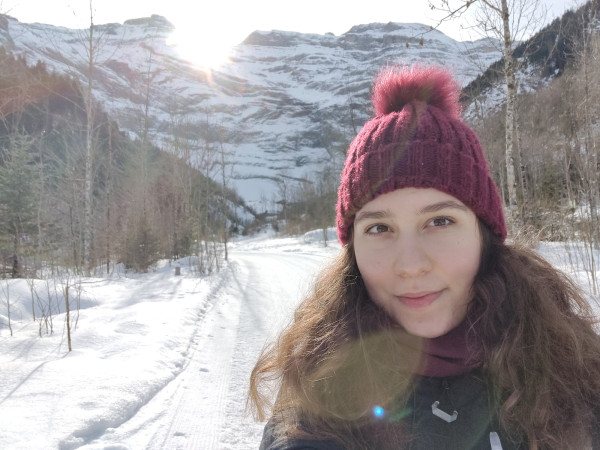
Veronika Lamparská
Interview by Nicola Nosengo, NCCR MARVEL on 6 March 2026
Have you always been interested in science?
When I was a child, I was always interested in how things worked. I wanted to become either a pilot or an aerospace engineer. At the same time, my dad really encouraged me to study physics since I was in primary school. He used to study with me and made me very enthusiastic about it. Also, when I was studying in the UK, I was able to choose only three or four subjects, so I picked math, physics and a little bit of chemistry, and that made me realise that I really liked it. I really liked mathematics because I didn’t have to memorize anything, I liked that it’s logical. So, I was kind of undecided between mathematics and physics but ended up studying physics.
How did you hear about the INSPIRE Potentials Program?
To be honest, I wanted to come here for the whole master’s, and I was looking at various fellowships and scholarships, and while I was looking into it, I discovered about the INSPIRE fellowship. But because it was only for the Master’s project, I decided to go to Germany for the main program instead and applied to come here only for six months. It was a very nice way to experience the environment in Switzerland.
What is the topic of your master’s project?
I am working on applying neural network quantum states to moiré materials. They are a fascinating class of systems where, by stacking very thin layers and slightly rotating them with respect to one another, we can create new patterns and are able to tune their physical behaviour. My focus is on TMDs, or transition metal dichalcogenides, that are promising candidates for future electronics. They may allow to produce devices that are more energy efficient. But they are challenging to study because their electrons are strongly correlated. It’s hard to model them using traditional methods, so people are trying to use machine learning to do it. I am working with an architecture called a message passing neural network to model these complex behaviours.
Do you think women face specific challenges in the sciences?
I think they do. One thing I’ve noticed is that when women strive to succeed, they’re not doing it just for themselves but for women in general. If a man makes a mistake, we tend to say that it’s because he did not know how to do that thing. It’s an individual judgement. But when a woman makes a mistake, there are people who say ‘women can’t do physics’. This places a lot of pressure on women to constantly perform well, a pressure that I don’t think boys and men feel the same way.
Any advice for young girls interested in science?
What helped me was that I was exploring a lot of different fields. First, I wanted to go into engineering, then particle physics and astronomy, and then I decided on condensed matter physics. I think it’s very important you do not put yourself in a box and try to do as many things as possible in terms of internships or just attend lectures and talk to people. Also, try not to make studies your whole world. Find time for your hobbies and for doing something creative. This way, if you fail at a test, your whole world does not just crash, and you will stay motivated in the long run. I wished I’d found that out myself a little bit sooner. As for myself, I like climbing and hiking, reading and cooking.
What are your plans for the future?
For the moment, I am trying to keep my options open. I’m looking for a PhD position, and I’m thinking of maybe going back to the Netherlands. I think I see myself more in the industry, as of now – but we’ll see. For sure, I would really like to stay in the condensed matter field.