Mridhula Venkatanarayanan
Interview by Nicola Nosengo, NCCR MARVEL on 2 June 2026
Have you always been interested in science?
I don’t think I was interested in science in the conventional sense growing up. One of my earliest ambitions was to become an archaeologist. Then there was a whole summer when I was 11 or 12 years old that I spent thinking about what could have caused the decline of the Indus Valley civilization, reading historical narratives from different parts of the country in search of clues. I was always interested in connecting ideas together. Growing up, I was a lot more into reading fantasy fiction, which I still am. I really like world-building and the way small details can make an entire world feel internally consistent. During high school, I had chemistry courses and learned about atoms and chemical bonding, then I learned quantum mechanics and this world really took shape for me. Right now, I am focussed on understanding materials from an atomistic point of view and how quantum effects could shape material properties at the larger scale. And this is how my scientific interest has been taking shape growing up: how smaller fragments contribute to a bigger picture. The curiosity is still the same.
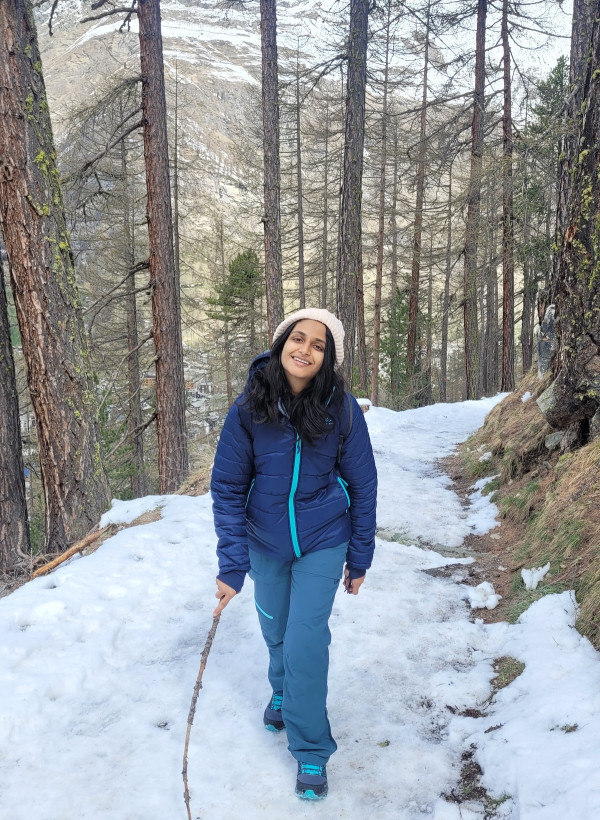
Mridhula Venkatanarayanan
How did you hear about the INSPIRE Potentials Program?
The reason I applied to EPFL for my master’s was the strong affinity it has for theoretical and computational research groups. While I was researching for that application, I came across the INSPIRE fellowship and made a note for myself to apply for it when the time would come.
What is the topic of your master’s project?
I am with Ivano Tavernelli’s group and I am developing quantum algorithms for efficient and scalable quantum chemistry simulations on current noisy hardware. The main problem or bottleneck with current simulations is that as the system becomes larger, the size of the quantum state space grows exponentially. Even the largest and most powerful classical supercomputers can only do so much. For strongly correlated systems or excited states it becomes trickier. That is one of the central promises of quantum computing, the fact it can represent and evolve quantum states much more naturally than classical computers. My project is about a method called SqDRIFT, which was developed by the Tavernelli team. It is a scalable randomized quantum algorithm used for quantum chemistry simulations that is designed to have shallow circuits and to be compatible with current noisy quantum hardware. My thesis is about how to develop add-ons to this method to explore the sub-space meaningfully. When you are dealing with highly correlated systems or excited states, you are not confined to a small region of the subspace, and you have to explore different corners of it. My thesis is about how to do it intelligently, also accounting for the fact that we are still using noisy hardware.
Do you think women face specific challenges in the sciences?
There are challenges that are deeply connected to the environment you grew up in. In my case, I come from a small town in India where the norm is that women are not supposed to have careers or even move away from home. In that setting it becomes really hard to see yourself in a scientific career. But I was fortunate because my mom did have a career and also raised two kids despite all the stereotypes. My dad was also very supportive throughout, encouraging us to pursue our own interests, build our own identities, and follow the careers we wanted for ourselves. Having a strong support system of mentors, colleagues, family is very important, especially men who can help bring women to the spotlight.
Any advice for young girls interested in science?
One advice I could share is to be selectively dumb about things. During my undergraduate, when I had the opportunity to do three fellowships at the same time, it was hard to envision myself doing this. I just committed to it and decided to think about the consequences later, even though I did not have the capacity to figure out administration or logistics all by myself. I had to start over three times in three different projects, but it was the right choice. Having the opportunity made me want to step up and build the capacity to do it even if I did not have it in the beginning.
What are your plans for the future?
For now, I am convinced that I want a PhD. The constant motivation so far has been to do good science and be in a good lab surrounded by smart people. I do not want to confine myself to one field or one methodology. One thing that stuck with me when I started my master is something Nicola Marzari said in the first class of his I attended. He pointed out that equations used in quantum mechanics can share mathematical similarities with models used in finance, such as the relationship between the Schrödinger equation and the Black-Scholes equation. And that is the kind of versatility I want to have as a researcher, identifying transferable ideas.