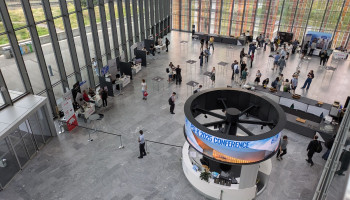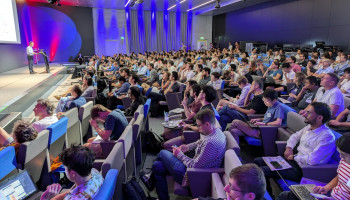
Major conference on theory and simulation of materials wraps up at SwissTech
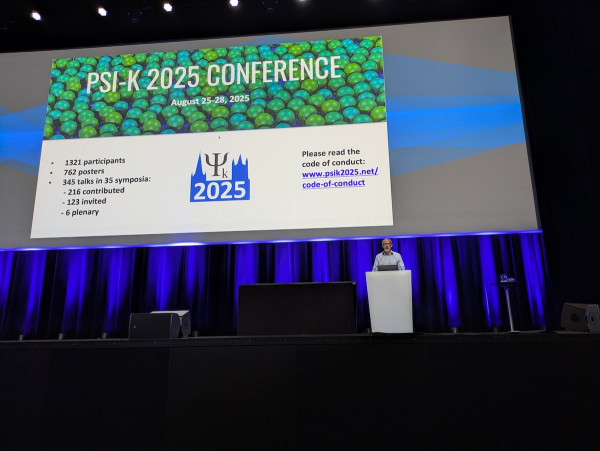
Psi-k 2025 chair Peter Haynes giving an overview of the conference.
According to conference chair Peter Haynes, “this edition of Psi-k has been an exceptional event in terms of showcasing the electronic structure methods community that is based not only in Europe, but around the whole world. The quality of the talks has been absolutely fantastic, from the plenary talks to invited and contributed talks and the poster contributions”.
MARVEL Director Nicola Marzari, from EPFL in Lausanne and the Paul Scherrer Institute gave the opening plenary lecture on “Moving on: from densities to spectral densities”, describing efforts to develop new theoretical frameworks for increasing the predictive accuracy of density functional theory. The other plenary speakers who opened or closed each day were Lilia Boeri from University of Rome Sapienza, Italy; Garnet Chan from California Institute of Technology, USA; Sharon Hammes-Schiffer from Princeton University, USA; Leeor Kronik from the Weizmann Institute of Science, Israel; and Roser Valentí from the Goethe-Universität Frankfurt am Main, Germany.
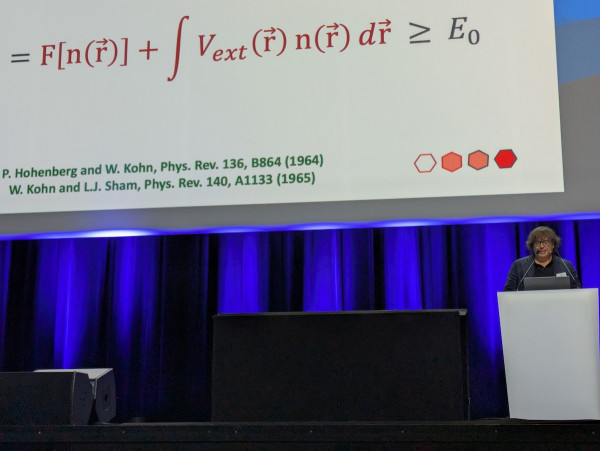
Nicola Marzari 's opening plenary lecture on 25 August.
The themes of the parallel symposia ranged from “Accelerating first-principles calculation across scales” to “First principles modelling of interfaces for energy storage and conversion”, from “Emerging artificial intelligence for computational materials discovery” to “Nanoscale materials and related phenomena”, and “Quantum computing and other emerging technologies”, also covering topics such as “Ethics and social responsibility” and “Materials for information and communication”. Alongside the packed scientific program, participants also enjoyed a gala evening at the MAD club in Lausanne.
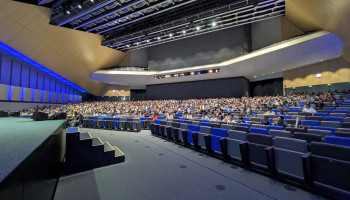
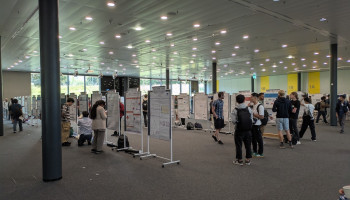
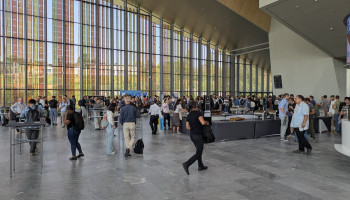
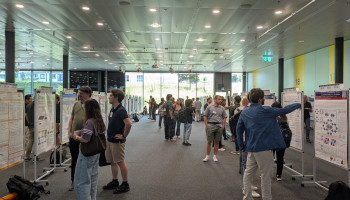
“Psi-k has all the energy of a bottom up community that does not need to answer to anyone but to itself” comments MARVEL director Nicola Marzari. “For the last 30 years it has grown from strength to strength and has helped train new generations of scientists. This is the conference where we learn about everything that has been happening around the world. I'm so happy that some of the central themes of the programme, such as materials discovery or improved accuracy, were actually themes that are very dear to me and to MARVEL”.